Full Stack App Developer: Skills and Career Guide
Learn what a full stack app developer does, which skills and tools matter, expected pay, and a clear path into this growing software career.

Understanding Full Stack Development
A full stack app developer builds both the visible and hidden parts of an app. Frontend development covers screens, forms, buttons, and page layout. Backend development handles data, rules, user accounts, and server tasks. This broad skill set lets one developer shape a feature from start to finish.
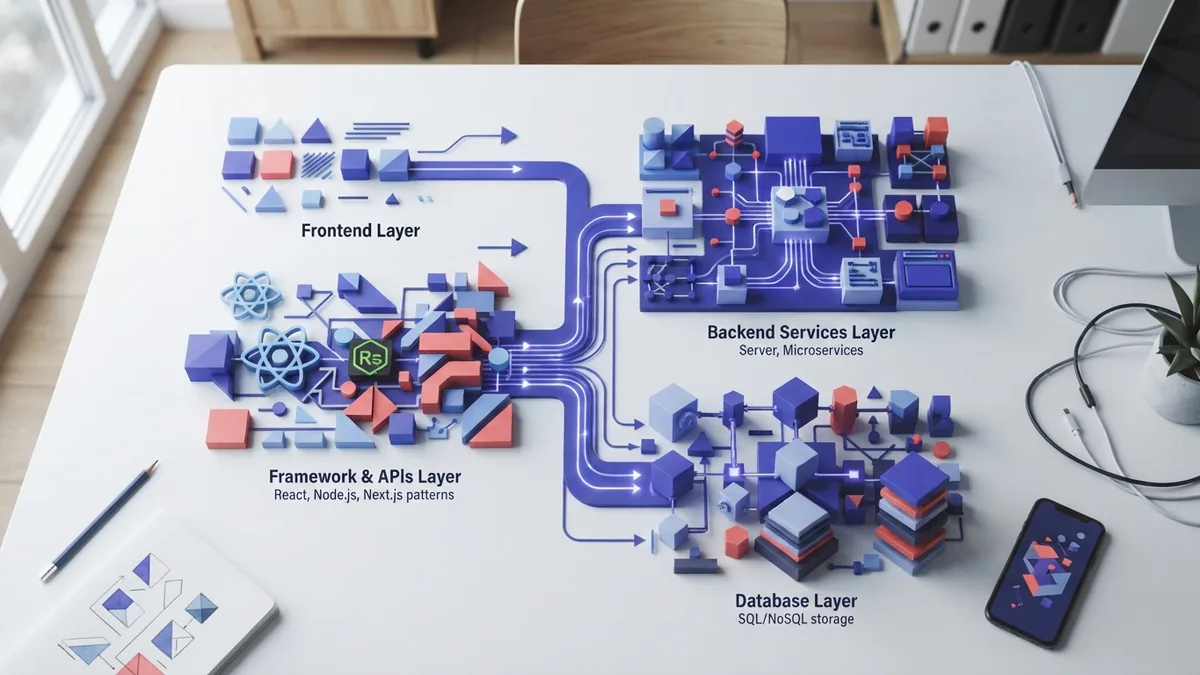
So, what is full stack development? It is the work of joining the client side, server side, and data layer. A simple shop app shows the idea well. The frontend displays products, the backend checks stock, and the database stores orders.
Full stack work does not mean knowing every tool. It means understanding how each layer connects. A good developer can trace a request from a button to a server and back again.
- Frontend: The part users see and use.
- Backend: The code that runs on a server.
- Database: The place where app data lives.
- Delivery: The tools used to test, ship, and track the app.

Key Skills Every Full Stack Developer Needs
The core full stack developer skills start with strong web basics. HTML gives a page its structure. CSS controls layout and style. JavaScript adds actions, data changes, and rich app behavior.
Learn to build layouts that work on phones and large screens. Practice form checks, error messages, and loading states. These small details shape trust. They also reduce support work after launch.
Backend skills matter just as much. Common choices include PHP, Ruby, Python, and Node.js. Each can receive requests, apply rules, and send back useful data.
You also need sound database management skills. MySQL stores data in linked tables. MongoDB stores flexible document records. Learn how to model data, write queries, protect access, and plan backups.
- Write clear code with small, testable parts.
- Use Git to track changes and review work.
- Read error logs and fix the root cause.
- Build secure sign-in and limit data access.
- Explain technical choices in plain language.
Popular Technologies and Frameworks
The technologies used in full stack development often form a stack. A stack is a set of tools that work together. One common path uses HTML, CSS, JavaScript, Node.js, and MongoDB.
Other teams choose Python with Django or Flask. Some use PHP with Laravel. Ruby on Rails remains useful for teams that value fast app builds. No stack wins every project.
Frameworks give you tested patterns for routing, views, data access, and app structure. They can speed up work. Yet they do not replace basic knowledge. Learn the web platform before leaning on a framework.
The MDN web development learning guide offers a trusted path through HTML, CSS, JavaScript, and browser skills. MDN is useful because it explains the platform first. That base makes any framework easier to learn.
| Layer | Common tools | Main use |
|---|---|---|
| Frontend | HTML, CSS, JavaScript | Build the user experience |
| Frontend framework | React, Vue, Angular | Manage rich screen updates |
| Backend | Node.js, Python, PHP, Ruby | Run app rules and services |
| Database | MySQL, MongoDB, PostgreSQL | Store and find app data |
Why Choose a Full Stack Developer Career?
Full stack work gives you a wide view of software development. You can spot gaps between the screen, server, and database. That view helps teams fix issues before they grow.
It can also bring more flexible project management. One developer may take a feature from plan to release. Small teams can move faster with fewer handoffs. This does not remove the need for specialists.
Full stack developers can test ideas with working prototypes. They can build a small version before a team spends more time. That skill helps founders, agencies, and product teams judge ideas with real use.
The tradeoff is breadth. You must keep several skill areas fresh. Deep work still matters, so most developers grow a strong focus over time.
- More control over complete features
- Better teamwork across frontend and backend roles
- Useful skills for freelance and startup work
- More context when planning project scope
Career Outlook and Salary
A full stack developer can work at a startup, agency, software firm, or large company. Job titles may include web developer, product engineer, or software engineer. The title changes, but the need for broad app skills stays strong.
A common US benchmark places full stack developer pay near $119,000 per year. Pay varies by city, company size, experience, and industry. Remote work can widen the range because employers may hire across many regions.
Public data often groups full stack work with wider software roles. The US Bureau of Labor Statistics software developer outlook covers pay, growth, and job duties for that larger group. Use it as a broad guide, not a promise for one job title.
Build a portfolio before you rely on job labels. Show how you made choices, fixed bugs, and handled real user needs. A clear project story can matter more than a long tool list.

How to Become a Full Stack Developer
Start with the web, not with a long list of frameworks. Learn HTML, CSS, and JavaScript through small builds. Make a page, add a form, and fetch data from a public service.
Next, pick one backend language. Python, PHP, Ruby, and JavaScript with Node.js are all valid choices. Stay with one path long enough to build comfort with files, requests, errors, and tests.
Then learn one database well. Build tables in MySQL or store documents in MongoDB. Add create, read, update, and delete actions. Protect private data from the start.
- Learn browser basics. Build responsive pages with HTML, CSS, and JavaScript.
- Choose a server path. Create routes, handle errors, and return useful data.
- Add a database. Store users, records, and app events with safe queries.
- Build one full app. Join the screen, server, and database in one project.
- Test and ship it. Use Git, write checks, and deploy a working version.
- Show your work. Explain the goal, key choices, limits, and next steps.
Keep each project small enough to finish. A task board, booking tool, or stock tracker can teach many core lessons. Finish one useful app before starting three new ones.
Review your code after each build. Remove repeated parts. Add better error handling. Ask another developer to review your work when possible.
Resources for Aspiring Full Stack Developers
Use a small set of strong resources. Official docs teach current rules and tool use. Practice sites can help, but your own projects build deeper skill.
Follow a study loop for each new topic. Read a short guide, copy a small example, then change it. After that, build the same idea without looking at the guide. This turns recall into real skill.
- Use MDN for browser and web platform basics.
- Read the official docs for your chosen backend tool.
- Use GitHub to review real project structure.
- Track bugs in a simple issue list.
- Join code reviews and explain your tradeoffs.
Set aside time for new tools each month. Emerging technologies can change how teams build and ship apps. Learn the reason behind a new tool before adding it to your stack.
Do not chase every trend. Ask whether a tool solves a real problem. Strong basics, steady practice, and finished projects create a durable career.
Frequently asked questions
- What does a full stack app developer do?
- A full stack app developer builds both the user-facing screens and the server code behind them. The role often includes database work, testing, and deployment.
- What skills does a full stack developer need?
- Core skills include HTML, CSS, JavaScript, one backend language, database work, Git, testing, and clear communication. Problem solving also matters because app parts must work together.
- Which technologies are used in full stack development?
- Common choices include HTML, CSS, JavaScript, React, Node.js, Python, PHP, Ruby, MySQL, MongoDB, and PostgreSQL. The best stack depends on the project and team.
- How long does it take to become a full stack developer?
- Many learners need several months to build basic apps and longer to gain job-ready skill. Your pace depends on study time, prior experience, and the number of projects you finish.
- Is full stack development a good career?
- It can suit people who enjoy broad software work and solving problems across many layers. The field also offers roles in startups, agencies, product teams, and large firms.
- What is the salary of a full stack developer in the US?
- A commonly cited US benchmark is about $119,000 per year. Actual pay varies with experience, location, company, and the role's exact scope.
Related reading

What Is Full Stack Software Development?
See how full stack developers build and connect the parts of modern software.

What Does a Full Stack Application Developer Do?
Explore the skills, pay, and career path of a full stack developer.

What Is a Full Stack Cloud Developer?
Explore the skills, tools, stacks, and career paths behind cloud development.